

- Author: Fraser Coombes ( Managing Director, Ray White Hamilton Property Management)
- Published Date: 23rd August, 2026
New IAWAI Charges Explained
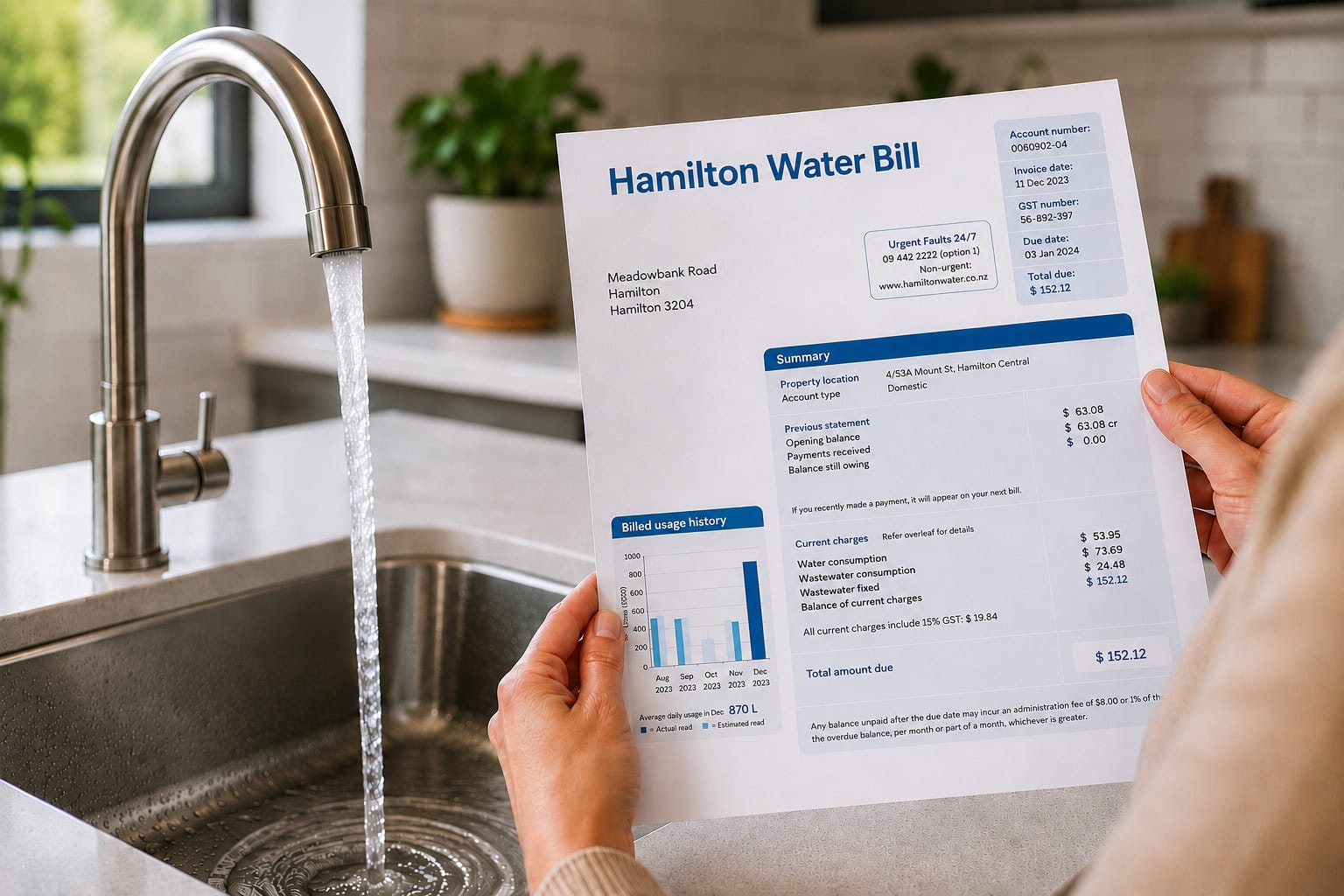
Hamilton property owners have started receiving their new-look rates and water invoices for the 2026/27 financial year.
The invoices now show Hamilton City Council rates and IAWAI water charges separately. Understandably, this has left many Hamilton landlords and tenants asking: Who pays the water bill in a rental property?
The short answer is that for an ordinary unmetered Hamilton rental property, the current IAWAI charges remain the landlord’s responsibility.
What has changed?
From 1 July 2026, IAWAI – Flowing Waters became responsible for delivering drinking water and wastewater services across Hamilton City and Waikato District.
Hamilton property owners will now see Council rates and IAWAI water and wastewater charges identified separately on one combined invoice.
Owners do not need to make two payments. The full amount remains payable to Hamilton City Council using the usual payment method. Existing regular payment arrangements should include both amounts automatically.
These are not charges for new services. Hamilton property owners have always contributed towards water and wastewater services through their rates. The new invoice simply makes those costs more visible.
How are Hamilton’s IAWAI charges calculated?
Hamilton’s residential IAWAI charges are currently calculated using:
- fixed charges per rating unit; and
- charges based on the property’s capital value.
They are not based on the amount of water used by the household.
For example, a recently issued invoice for a Hamilton property with a capital value of $700,000 showed annual IAWAI charges of $1,083.77:
- $28.00 fixed water-supply charge;
- $526.79 capital-value-based water-supply charge;
- $14.00 fixed wastewater charge; and
- $514.98 capital-value-based wastewater charge.
None of that amount was calculated according to the tenant’s actual water consumption.
This is the critical distinction: the invoice now separately identifies the cost of water services, but it does not measure the tenant’s water use.
Does the landlord or tenant pay?
Under the current Hamilton charging system, the landlord pays.
According to Tenancy Services’ guidance, a tenant is generally responsible for water charges only when:
- the property has its own separate water meter;
- the supplier charges according to metered consumption; and
- the charge can be exclusively attributed to the tenant’s use.
Hamilton’s current fixed and capital-value-based charges do not meet these requirements. A landlord cannot simply pass the separately identified IAWAI amount on to the tenant as a water-usage bill.
Rising rates and water-service charges can be considered as part of an owner’s overall investment planning and any lawful rent review. That is different from directly invoicing a tenant for the IAWAI charge.
Are water meters coming to Hamilton?
Yes. IAWAI has confirmed a four-year programme to introduce residential water meters throughout Hamilton.
However, installing meters and introducing usage-based charging are two separate decisions.
IAWAI has not yet finalised when volumetric charging will begin or how future accounts will be divided between fixed property charges and charges based on actual consumption.
If Hamilton eventually adopts a model similar to Auckland, Waipā and other metered areas, tenants may become responsible for eligible charges directly attributable to their water use. Landlords would continue to pay applicable fixed and property-based costs.
Before that happens, clear processes will be required for meter readings, shared meters, leaks, wastewater calculations, changes of tenancy and the recovery of tenant consumption charges.
What should landlords and tenants do now?
Landlords should continue paying the full combined Council and IAWAI invoice. The current IAWAI amount should not be passed directly to tenants.
Tenants do not need to do anything differently at present but should promptly report leaking taps, running toilets, unexplained water pooling or other suspected leaks.
As Hamilton moves towards residential water metering, identifying leaks and understanding household consumption will become increasingly important.
Ray White Hamilton Property Management is here to help
With more than 2,000 rental properties under management, Ray White Hamilton Property Management understands the practical implications these changes may have for landlords and tenants.
We will continue monitoring IAWAI’s water-meter rollout and future charging model. As details are confirmed, we will provide clear guidance and update our processes to ensure water charges are managed accurately, fairly and in accordance with New Zealand tenancy law.
For now, the position is clear:
Hamilton’s water rating invoice has changed, but the responsibilities of unmetered landlords and tenants have not.
Fraser Coombes –
Managing Director, Ray White Hamilton Property Management